Mooney M20 Checklist
A free, printable Mooney M20 checklist — 20 sections from Preflight Inspection to Landing Gear Malfunction / Emergency Extension, free to edit, sized for a kneeboard.
What the Mooney M20 is
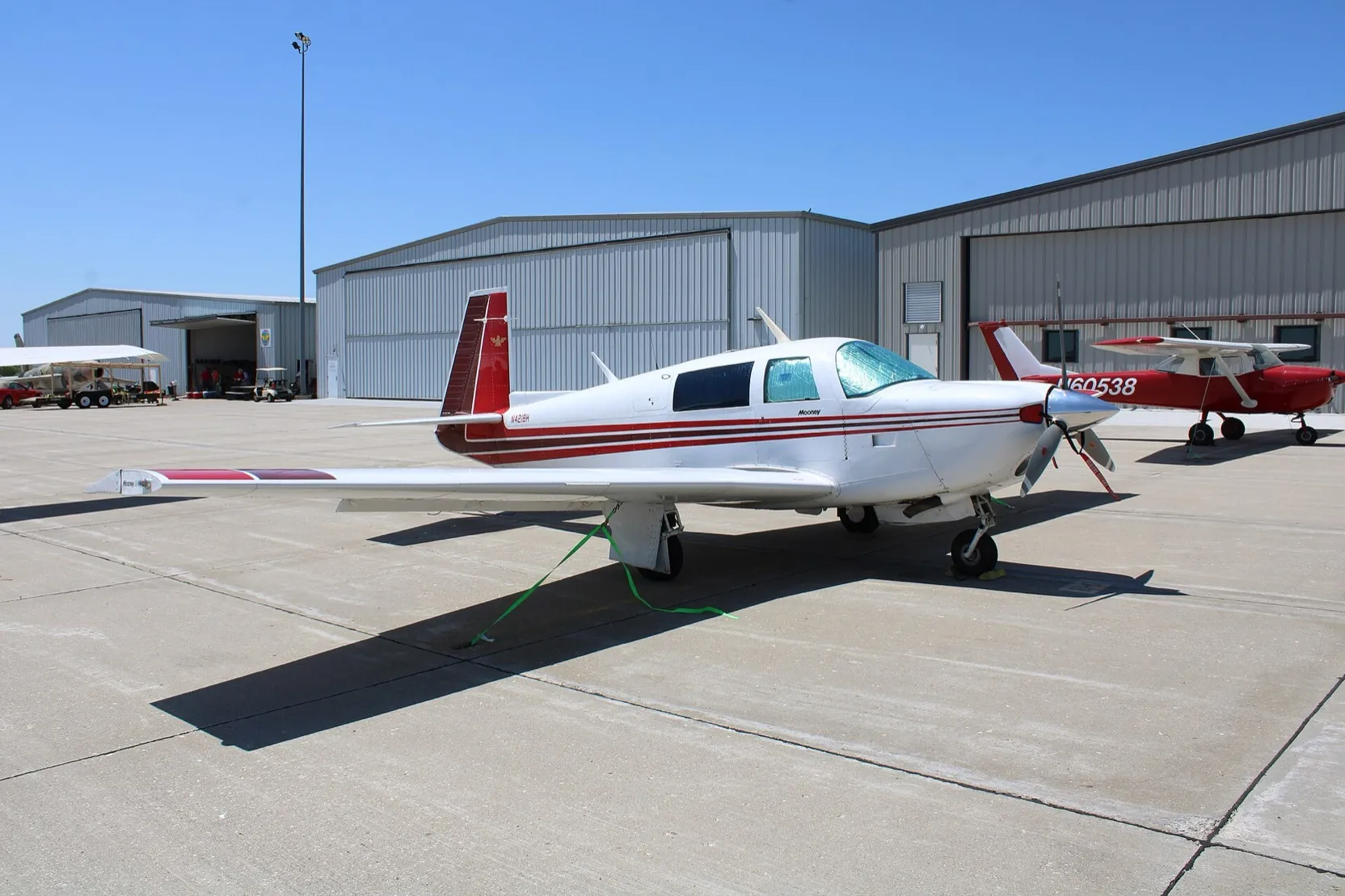
A fast retractable single, in production on and off since 1955, easy to spot by the forward-swept tail. This checklist centers on the M20J “201”: normally aspirated, fuel-injected Lycoming IO-360, built 1977 to 1997, named for the 201 mph Mooney got from 200 hp with an aerodynamic cowl and gear fairings. Other letters don’t transfer. The carbureted C, E, and F crank the gear up with a manual “Johnson bar,” the K “231” is turbocharged, the Bravo, Ovation, and Acclaim are big-bore. The J is the one most pilots fly, usually stepping up from a 172 or a Cherokee, and it brings a constant-speed prop, a gear handle, and a fuel selector with no BOTH position. Snug cabin, one door, on the right.
The airframe is slippery enough that a little extra speed down final costs you real runway, so this checklist is built around flying the published number. I used the 201 because it’s the Mooney most people rent and train in, and gear-down, three-green sits at every pattern position where somebody has landed one wheels-up. Print it, add your tail number, fly the numbers in your own POH.
Normal procedures
Preflight through securing: before start, start, taxi, run-up, takeoff and initial climb, climb, cruise, descent, before landing, after landing, plus a Mooney M20J V-speed table. Two items repeat on purpose. Gear down, three green at every pattern position, and the LEFT/RIGHT/OFF fuel selector (no BOTH) so tank management stays deliberate. Configure early; this airplane does not slow down for you.
Emergency procedures
Memory items are bold. Covered: engine failure on the takeoff roll, engine failure after takeoff, engine failure in flight with a restart attempt, engine fire, electrical fire and smoke, an alternator/electrical abnormal, and a gear that won’t confirm down and locked. That last one carries the caveat. The J’s electric gear has a hand-crank backup, and you pull the gear-motor breaker before cranking so you aren’t fighting a powered motor, but crank direction, breaker label, and max airspeed changed between 1977 and 1978+ production. Verify it with your POH and a CFI.
Verify it against your POH
What varies by variant, model year, and serial. Check each against your approved POH/AFM:
- Emergency gear extension. Highest priority. Pull the gear-motor breaker before hand-cranking, then confirm crank direction, breaker label, and max airspeed for your serial: 1977 and 1978+ differ, and this detail is forum-sourced.
- Vfe. Sources ranged 110–132 KIAS and split on whether there’s one Vfe or two. Use one POH revision.
- Vlo / Vle. A mid-production change raised gear/flap limits from about 107 to 132 KIAS. Find your serial break.
- Takeoff flaps. Clean (0°) or a takeoff setting, depending on the source. Confirm for your model year.
- Boost pump ON/OFF timing across takeoff and climb. Commonly flown, not confirmed against POH wording.
- Fuel selector at shutdown. On a tank or off reads as operator policy, not a POH mandate.
- Short and soft field. Technique notes here, not a verified J-specific POH procedure.
- Variant deltas. These Mooney M20 V-speeds are 201-representative; the turbo K “231” and the Johnson-bar C, E, and F differ.
Why not just print a static PDF?
- It's free with no caps — build, edit, save, and print as many as you want.
- You can add your own tail number and logo, so the checklist matches your airplane.
- Every page size is here — half-letter, A5, letter, and folding trifold or 2-up.
A PDF from the internet doesn't know your tail number, your panel, or your instructor's habits. Build your own in the time it takes to read this page — still free.
What's inside
- Preflight Inspection
- Before Start
- Engine Start
- Before Taxi & Taxi
- Run-up & Before Takeoff
- Takeoff & Initial Climb
- Climb
- Cruise
- Descent
- Before Landing
- After Landing
- Shutdown & Securing
- V-Speeds (M20J “201”, typical)
- EmergencyEngine Failure on Takeoff Roll
- Engine Failure After Takeoff (Low Altitude)
- Engine Failure in Flight (Altitude Available)
- Engine Fire in Flight
- Electrical Fire / Smoke in Cockpit
- Alternator / Electrical Failure (Abnormal)
- Landing Gear Malfunction / Emergency Extension (Abnormal)
Questions pilots ask
- Is there a printable Mooney M20 emergency checklist here?
- Yes. The emergency section covers engine failure on the takeoff roll, engine failure after takeoff, engine failure in flight with a restart attempt, engine fire, electrical fire / smoke, an alternator/electrical abnormal, and a landing-gear-malfunction / emergency-extension flow, with the memory items in bold. The manual-extension detail rests on secondary sources, so confirm the crank direction, breaker, and airspeed limit against your serial's POH before you rely on it.
- What speeds are in the Mooney M20 checklist?
- The checklist carries an M20J "201"-representative V-speed table. Watch two gear/flap-limit items: Vfe showed an inconsistent 110–132 KIAS spread and sources disagreed on whether there is one Vfe or two, and a mid-production change raised Vlo/Vle (about 107 to 132 KIAS) at a specific serial break. Confirm the figures for your model year in a single POH.
- My Mooney has a manual crank for the gear — is that the same as an old Johnson-bar Mooney?
- No, and the difference matters. The early M20, M20A, and many M20C models used a manual "Johnson bar" as the primary gear system. The M20J "201" has fully electric gear; the hand crank is an emergency backup only. Before you use it, you pull the gear-motor circuit breaker so you are not cranking against a still-powered motor, which has damaged the system on airplanes where pilots skipped that step. Confirm your serial's exact procedure, breaker, and airspeed limit in the POH.
- Why does the fuel selector matter so much on this checklist?
- Because the M20 selector has no BOTH position — it is Left, Right, or Off. Unlike a simple Cessna with a BOTH setting, you have to actively manage tank balance and remember which tank you are feeding from. After every tank switch, keep a hand near the selector for about fifteen seconds and confirm fuel pressure holds before you trust it. That is why the selector shows up as a repeated killer item across the flows.
- Why is speed control such a big deal on approach?
- The M20 is a clean, slippery airframe that accelerates fast and does not want to slow down. Carrying excess speed over the fence increases landing distance sharply — much more than in a draggy trainer. The type's owner community stresses flying the precise reference speed for your weight rather than adding a cushion "for the family." Fly the number, and configure early.
Related aircraft
_(5-27-2023).jpg)
New to checklists? Read our guide to building an aircraft checklist →
Need the official numbers? Mooney M20 POH & manuals →